The Nine Attempts
How Pasta al Limone Found Its Place on Our Menu
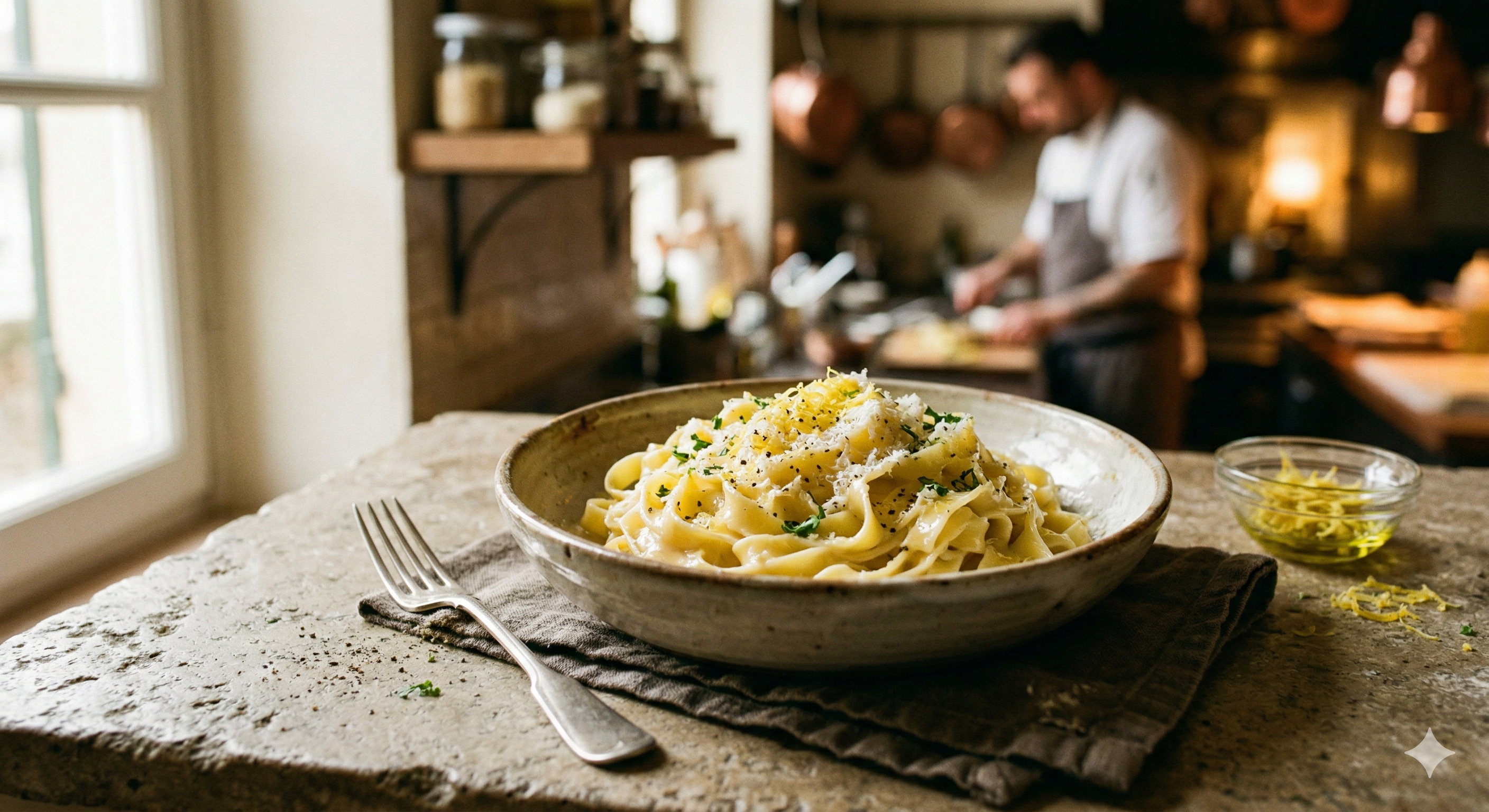
There is a particular kind of obsession that lives inside a kitchen. Not the loud, dramatic kind you see on television, but the quiet, methodical kind that keeps you standing at the stove long after the service is done, adjusting, tasting, adjusting again. For me, that obsession took the shape of a lemon. More precisely, it took the shape of nine attempts to make a lemon sing inside a pasta dish in a way that felt both honest and extraordinary.
This is the story of how Pasta al Limone came to be on our menu at Bread and Brew. Not as a borrowed recipe, not as a shortcut adaptation, but as something built from the ground up, failure by deliberate failure.
The Beginning: A Blank Slate and a Pasta Dough
When the conversation came up about expanding our menu, my instinct went immediately to pasta. It always does. Italian cuisine holds a particular fascination for me. It is a cuisine that respects its ingredients to the point of near-religion. Within Italian pasta traditions, Pasta al Limone stood out immediately. Simple. Bright. The kind of dish where every element is exposed and there is nowhere to hide. That simplicity was exactly what made it dangerous, and exactly what made it irresistible.
I started where I always start with pasta: the dough.
My choice was fettuccine. Wide enough to carry a sauce, substantial enough to give texture on the palate, and classically suited to a cream-adjacent preparation. I built the dough with semolina, water, salt, and olive oil. No eggs in this first version. I wanted to understand the structure of the pasta itself before layering complexity into it.
The excitement of working that dough for the first time was real. There is something grounding about the process. The way semolina resists initially, then gradually yields as hydration absorbs, the way the olive oil creates a subtle extensibility without making the dough slack. When I ran the first batch through the pasta machine and cut the fettuccine, the result was genuinely good. Clean, structured, with the slight roughness that semolina gives, which would later prove important for how the sauce would cling.
The one variable that immediately flagged itself: thickness. The pasta was slightly too thick on the first pass, which meant the cooking time was off and the bite, that critical al dente resistance, wasn't quite where it needed to be. I logged it. Adjusted the machine setting. Filed it as a variable to return to.
Building the Sauce: The Pursuit of Balance
With the pasta framework established, the sauce became the central problem to solve. My brief to myself was clear: authentic, simple, not too heavy on cream, but tangy in a way that felt generous rather than sharp. The OG Italian version of this dish is deceptively minimal: butter, lemon zest, lemon juice, a touch of pasta water, parmesan, and sometimes a whisper of cream. The architecture was elegant. The execution, I would quickly discover, was unforgiving.
The ingredients themselves were never in question. What followed over the next eight to nine attempts was a disciplined, sometimes frustrating interrogation of measurement and ratio. Every element was a moving variable. The lemon juice too assertive in one iteration, the butter overwhelming the citrus in another, the parmesan seizing and creating a grainy texture when the temperature was wrong, the pasta water either thinning the sauce too aggressively or not emulsifying it properly when added in the wrong sequence.
What became clear very quickly is that Pasta al Limone is fundamentally a lesson in balance. Not the static balance of a composed plate, but a dynamic balance, where each component is constantly in conversation with the others. Change the lemon measurement and suddenly the cream needs to shift. Adjust the parmesan and the acidity reads differently. Add the pasta water too soon and the emulsion breaks.
I kept notes after every attempt. Exact measurements. Temperature at time of plating. Resting time. The thickness of the pasta that day. Humidity in the kitchen (yes, that matters with fresh pasta). Each attempt generated data. Each failure narrowed the variable space.
Attempt Nine: The Moment It Became Real
The ninth attempt was different from the moment the sauce came together in the pan. There is a visual cue that experienced cooks learn to read. The way a properly emulsified pasta sauce moves, slightly glossy, coating the back of a spoon without being heavy, releasing steam that carries the aroma cleanly. On that ninth attempt, the sauce moved correctly.
The taste confirmed it. The lemon was present, unmistakably and confidently present, but it didn't dominate. The richness of the butter and parmesan cushioned the acidity without smothering it. The fettuccine, by this point dialed to the correct thickness, had the right tooth, and the sauce clung to each strand in the way that makes you want to eat it fast before it changes.
I called it. This was the dish.
One Week, Then the Table
We spent a week after finalising before the dish went on the menu. That week was about consistency. Making sure the dish could be reproduced across a service, under pressure, by hands other than mine. Replicability is the real test of any dish. A recipe that only works when its creator is in a meditative state at 2pm on a quiet Tuesday is not a restaurant dish. This one held.
The first customer to order it came back to the pass with one word: "Wow."
In nine attempts, in all the logged measurements and adjusted ratios and reset expectations, that was the outcome I was working toward. Not complexity. Not technique on display. Just a person tasting something simple and feeling, unmistakably, that it was good.
That is what Italian cuisine has always known. That is what the lemon was trying to tell me from the beginning.